
Native SDK
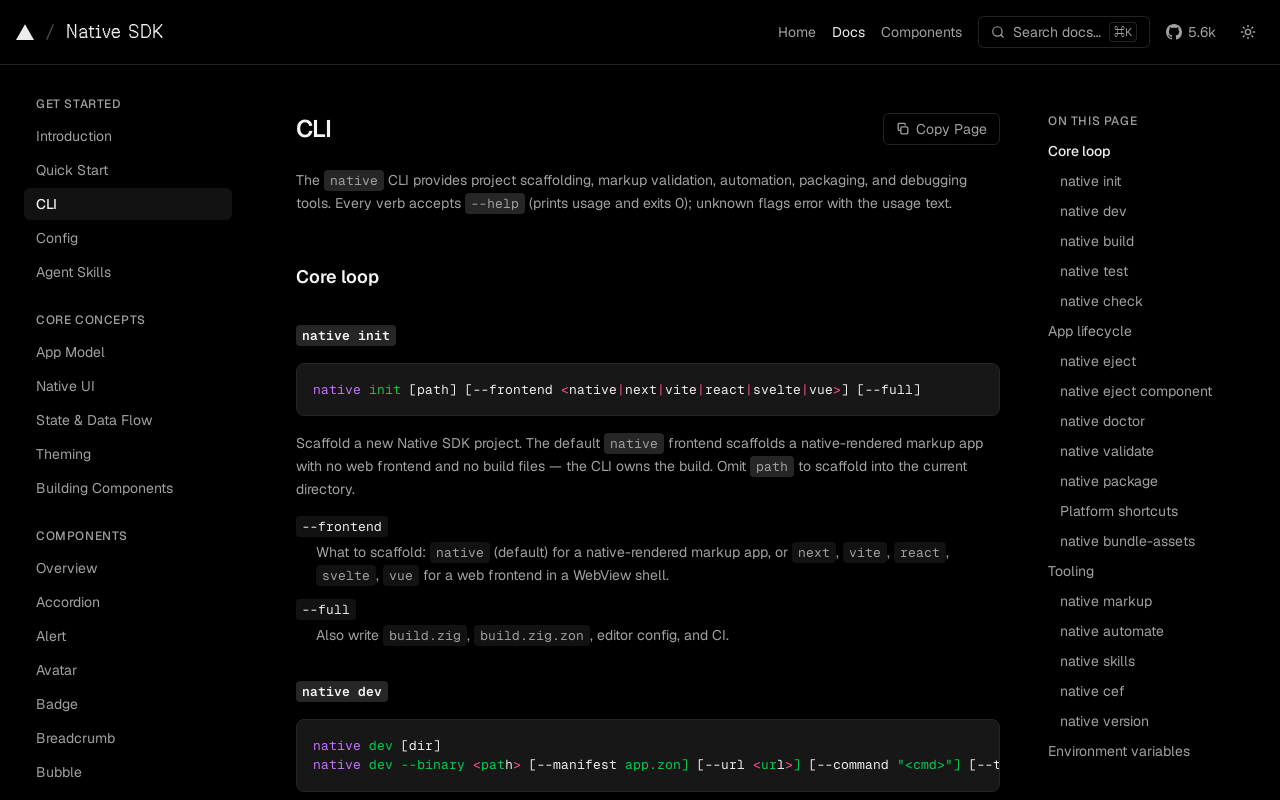
Native SDK is a development toolkit for building native desktop and mobile applications using a custom markup language (Native UI) and the Zig programming language. It provides a CLI for project scaffolding, hot-reload development, testing, packaging, and automation, along with a comprehensive component library and cross-platform support.
Key facts
What is Native SDK?
Build native desktop and mobile applications with a single codebase using Native markup and Zig, with built-in hot-reload, testing, and distribution tooling.
Who is Native SDK best for?
Desktop and mobile app developers using Zig, teams building cross-platform native UIs
What are its main limitations?
- Requires knowledge of Zig and the custom Native markup language
- Documentation may be limited for advanced use cases (e.g., custom WebEngine integration)
Limitations are based on product materials or editorial synthesis; confirm on the official site.
Key features
- ✓Project scaffolding with multiple frontend options (native, Next, Vite, React, Svelte, Vue) via `native init`
- ✓Hot-reload development server with debug diagnostics via `native dev`
- ✓Markup validation, model-contract checking, and accessibility findings via `native check` and `native markup check`
- ✓Integrated test suite runner via `native test`
- ✓Automation server for snapshot, screenshot, and widget interaction scripting via `native automate`
- ✓Packaging for macOS, Linux, Windows, iOS, and Android via `native package`
- ✓Component library with 40+ UI components (Button, Table, Dialog, etc.) and ability to eject composite components as owned code
- ✓Cross-platform support for Windows, macOS, Linux, iOS, Android, and embedded/WebView contexts
Use cases
- →Scaffold a new native desktop application with a web frontend (React, Vue, etc.)
- →Develop and hot-reload a native UI markup app with live updates
- →Automate UI testing with snapshot, screenshot, and widget interaction commands
- →Package a completed app for distribution on multiple platforms
- →Build a system tray application with menus and keyboard shortcuts
- →Embed a web browser (WebView) and communicate with native code via Bridge commands
Pros
- +Hot-reload markup and model-contract checking accelerates development
- +Built-in automation server enables deterministic UI testing without third-party tools
- +Supports multiple frontend frameworks and cross-platform packaging out of the box
- +Component ejection allows customization of library composites into owned code
Cons
- −Requires knowledge of Zig and the custom Native markup language
- −Documentation may be limited for advanced use cases (e.g., custom WebEngine integration)
Positioning
- Core value: Build native desktop and mobile applications with a single codebase using Native markup and Zig, with built-in hot-reload, testing, and distribution tooling.
- Ideal for: Desktop and mobile app developers using Zig, teams building cross-platform native UIs
- Product type: CLI tool, development framework, and component library
Frequently asked questions
What is the Native SDK?
The Native SDK is a set of tools and libraries for building native desktop and mobile applications using a custom markup language (Native UI) and the Zig programming language. It includes a CLI for project management, a component library, and automation/testing support.
How do I create a new project?
Use the `native init [path] [--frontend ...]` command. By default it scaffolds a native-rendered markup app. You can choose a web frontend (Next, Vite, React, Svelte, Vue) to run in a WebView shell.
What frontends are supported?
The default is the native markup frontend, but you can also scaffold projects with Next.js, Vite, React, Svelte, or Vue as the frontend layer inside a WebView.
How do I package my app for distribution?
Use `native package --target <macos|linux|windows|ios|android> [flags]`. The CLI handles building and packaging binaries for the target platform. Per-platform shortcuts like `native package-windows` are also available.
What is the automation server?
The automation server is a built-in feature of automation-enabled apps. It allows you to script interactions like taking snapshots, screenshots, clicking widgets, and dispatching input events using `native automate` commands—useful for testing and CI.
What markup format does Native SDK use?
The markup format is called Native UI markup (files with `.native` extension). It is a custom XML-like language for describing UI components and their bindings. The CLI provides validation and a language server (LSP) for editor integration.
You may also like
Curated suggestions based on similar categories.
CodeTrain
A website that helps software engineers keep their skills on track by solving coding challenges, exploring new technologies, and trying new tools and languages. It offers challenges in categories including Code, Blockchain, and Docker.
Typer
Typer is a library for building CLI applications based on Python type hints. It is easy to code and use, with automatic help and completion for all shells. It also includes a command line tool to run scripts, automatically converting them to CLI applications.
Astryx
Astryx is an open source design system by Meta, built on React and StyleX, offering over 160 accessible and themeable components. It is fully customizable, agent-ready, and includes templates, themes, and documentation for rapid UI development. Currently in Beta.
Drizz
Drizz is an AI-powered mobile test automation platform that uses Vision AI to author, execute, and maintain tests for real apps. It offers self-healing tests, plain English authoring, real-device execution, and CI/CD integration, reducing flakiness to 5%.
AdsGPT Pricing Plans - Simple & Transparent
HelloChusquis is an open-source AI terminal agent with a chat interface, web search, file management, code execution, and multi-provider AI integration. It supports over 15 AI providers including OpenRouter, Ollama, OpenAI, Anthropic, and Gemini, and offers a web interface and REST API.
Keploy
Keploy is an open-source, AI-powered testing platform that captures real API traffic using eBPF and replays it in CI as deterministic regression tests, auto-generated mocks, and production-like sandboxes — with zero code changes. It supports any language (Go, Java, Python, Node.js, Rust, PHP, Ruby) and any framework.